
Solar Logic Circuits Guide: Difference between revisions
More actions
m Remove translation markup (automated) |
Starviking (talk | contribs) →Disclaimer: Changed descript to be agnostic regarding sensor point. |
||
| Line 7: | Line 7: | ||
The designs on this page are valid as of v0.2.5906.26015 (2025-09-16) | The designs on this page are valid as of v0.2.5906.26015 (2025-09-16) | ||
Guides in this section calls out the [[sensor]] being placed in a specific orientation, but not all guides use the same orientation. When follow a a guide please be sure to place your sensor and solar panel as described in the guide. | |||
to | |||
== Geometry Of [[Solar Panel|Solar Panels]] and [[Sensors#Daylight Sensor|Daylight Sensors]] == | == Geometry Of [[Solar Panel|Solar Panels]] and [[Sensors#Daylight Sensor|Daylight Sensors]] == | ||
| Line 22: | Line 20: | ||
=== Six-chip dual-axis tracking === | === Six-chip dual-axis tracking === | ||
To get a "100%" accurate solar tracker on planets with an offset solar arc, you need to include the Horizontal component to the solar angle. | To get a "100%" accurate solar [[tracker]] on [[planets]] with an offset solar arc, you need to include the Horizontal component to the solar angle. | ||
'''What do you need:''' | '''What do you need:''' | ||
| Line 30: | Line 28: | ||
* [[Sensors|Kit (Sensor)]] > [[Sensors#Daylight Sensor|Daylight Sensor]] | * [[Sensors|Kit (Sensor)]] > [[Sensors#Daylight Sensor|Daylight Sensor]] | ||
Place the Daylight Sensor facing up, '''with the Data Port facing north (0 degrees).''' | Place the [[Daylight Sensor]] facing up, '''with the [[Data Port]] facing north (0 degrees).''' | ||
{| class="wikitable" | {| class="wikitable" | ||
| Line 38: | Line 36: | ||
! '''Chip''' !! '''Chip label''' !! '''IN''' !! '''VAR''' !! '''OUT''' | ! '''Chip''' !! '''Chip label''' !! '''IN''' !! '''VAR''' !! '''OUT''' | ||
|- | |- | ||
| Logic Reader || Horizontal Reader || Daylight Sensor || Horizontal || | | [[Logic]] Reader || Horizontal Reader || Daylight Sensor || Horizontal || | ||
|- | |- | ||
| Batch Writer || Horizontal Writer || Horizontal Reader || Horizontal || Solar Panel | | Batch Writer || Horizontal Writer || Horizontal Reader || Horizontal || [[Solar Panel]] | ||
|- | |- | ||
! '''Vertical''' | ! '''Vertical''' | ||
| Line 52: | Line 50: | ||
! '''Chip''' !! '''Chip label''' !! '''Value''' | ! '''Chip''' !! '''Chip label''' !! '''Value''' | ||
|- | |- | ||
| Logic Memory || Vertical Correction Memory || 90 | | [[Logic Memory]] || Vertical Correction Memory || 90 | ||
|- | |- | ||
! '''Chip''' !! '''Chip label''' !! '''IN 1''' !! '''IN 2''' !! '''OUT''' | ! '''Chip''' !! '''Chip label''' !! '''IN 1''' !! '''IN 2''' !! '''OUT''' | ||
| Line 61: | Line 59: | ||
[[File:2022-10-02 Two-axis solar tracking.png|Accurate two-axis solar tracking]] | [[File:2022-10-02 Two-axis solar tracking.png|Accurate two-axis solar tracking]] | ||
The panels should align themselves to the sun, you make sure to '''put the Power Port on the panels facing east (east - 90 degrees).''' If you've already built the panels and logic with the Power Port facing west, swapping the direction of the sensor so that its Data Port faces south will allow the setup to work with no additional changes. | The panels should align themselves to the sun, you make sure to '''put the [[Power]] Port on the panels facing east (east - 90 degrees).''' If you've already built the panels and logic with the Power Port facing west, swapping the direction of the sensor so that its Data Port faces south will allow the setup to work with no additional changes. | ||
== Solar tracking using Integrated Circuits == | == Solar tracking using Integrated Circuits == | ||
| Line 78: | Line 76: | ||
A simple code example can be found here: https://stationeering.com/tools/ic/_2FpmwojGnBq<br> | A simple code example can be found here: https://stationeering.com/tools/ic/_2FpmwojGnBq<br> | ||
This code is considered "inefficient" since it's hard-coded to spam all types of solar panels, even if you don't have them. | This code is considered "inefficient" since it's hard-coded to spam all types of [[solar panels]], even if you don't have them. | ||
A better code example can be found here: https://stationeering.com/tools/ic/_2FpoBEcd3QK<br> | A better code example can be found here: https://stationeering.com/tools/ic/_2FpoBEcd3QK<br> | ||
It targets the solar-panel types on '''d2''' and (optionally) '''d3''', so it's less spammy. It also has an option for a display ('''Kit (Console)''') on '''d1''' that shows the sum of power output from both types of panels | It targets the solar-panel types on '''d2''' and (optionally) '''d3''', so it's less spammy. It also has an option for a display ('''Kit ([[Console]])''') on '''d1''' that shows the sum of power output from both types of panels | ||
== duality of orientation == | == duality of orientation == | ||
Revision as of 23:58, 21 March 2026
Disclaimer
Due to the frequency of game updates, all solutions are subject to change and may or may not be functional.
The designs on this page are valid as of v0.2.5906.26015 (2025-09-16)
Guides in this section calls out the sensor being placed in a specific orientation, but not all guides use the same orientation. When follow a a guide please be sure to place your sensor and solar panel as described in the guide.
Geometry Of Solar Panels and Daylight Sensors
-
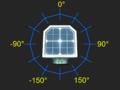 Geometry of values measured by daylight sensor in horizontal (yaw) mode
 -
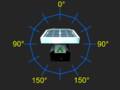 Geometry of values measured by daylight sensor in vertical (pitch) mode
 -
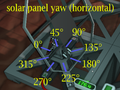 Effect of setting horizontal rotation of a solar panel


Solar tracking using Logic Chips
Six-chip dual-axis tracking
To get a "100%" accurate solar tracker on planets with an offset solar arc, you need to include the Horizontal component to the solar angle.
What do you need:
Place the Daylight Sensor facing up, with the Data Port facing north (0 degrees).
| Horizontal | ||||
|---|---|---|---|---|
| Chip | Chip label | IN | VAR | OUT |
| Logic Reader | Horizontal Reader | Daylight Sensor | Horizontal | |
| Batch Writer | Horizontal Writer | Horizontal Reader | Horizontal | Solar Panel |
| Vertical | ||||
| Chip | Chip label | IN | VAR | OUT |
| Logic Reader | Vertical Reader | Daylight Sensor | Vertical | |
| Batch Writer | Vertical Writer | Vertical Correction Math | Vertical | Solar Panel |
| Chip | Chip label | Value | ||
| Logic Memory | Vertical Correction Memory | 90 | ||
| Chip | Chip label | IN 1 | IN 2 | OUT |
| Logic Math | Vertical Correction Math | Vertical Reader | Vertical Correction Memory | Add |

The panels should align themselves to the sun, you make sure to put the Power Port on the panels facing east (east - 90 degrees). If you've already built the panels and logic with the Power Port facing west, swapping the direction of the sensor so that its Data Port faces south will allow the setup to work with no additional changes.
Solar tracking using Integrated Circuits
This is the most powerful way to track the sun, but the implementation might be a bit daunting at first.
What you need:
And if you don't already have one set up:
Place the Daylight Sensor facing up, note which direction the Data Port is facing, and which direction the solar panel Power Port is facing. These two directions are needed in the code. The Daylight Sensor is connected to the d0 screw, that's all you need.
A simple code example can be found here: https://stationeering.com/tools/ic/_2FpmwojGnBq
This code is considered "inefficient" since it's hard-coded to spam all types of solar panels, even if you don't have them.
A better code example can be found here: https://stationeering.com/tools/ic/_2FpoBEcd3QK
It targets the solar-panel types on d2 and (optionally) d3, so it's less spammy. It also has an option for a display (Kit (Console)) on d1 that shows the sum of power output from both types of panels
duality of orientation
Due to the coordinate system used by solar panels, it is actually possible to capture peak sunlight using two different (but related) H,V coordinates.

This screenshot shows two sets of solar panels, each with its own daylight sensor. Each sensor is oriented differently to properly match its panel and formulas. The panel on the right uses panel.horizontal = daysensor.horizontal; panel.vertical = 90-daysensor.vertical; while the panel on the left uses panel.horizontal = daysensor.horizontal; panel.vertical = daysensor.vertical + 90. They both achieve the same orientation.